
Most popular
- The Great Imperial Crown – the masterpiece of the russian jewellery art presented in Moscow
- Alrosa Produces 7.5 Mln Carats in Q1, Sales Up to $1.22 Bln
- Jewellery retail has grown by 19 % in 2011
- Moscow Bourse Bringing Buyers to Diamond Week in Israel
- Russia: What the Buyer Economizes on and How He Puts on the Ritz
Russia’s entry into the World Trade Organization at the beginning of this year did not automatically mean that the country’s high tariff barriers to gems and jewelry imports would go down anytime soon.
Alex Popov, President of the Moscow Diamond Bourse, said that while the bourse had been strongly lobbying the government for either abolition or at least a reduction in customs duty, “the actual reduction could even take many years.”
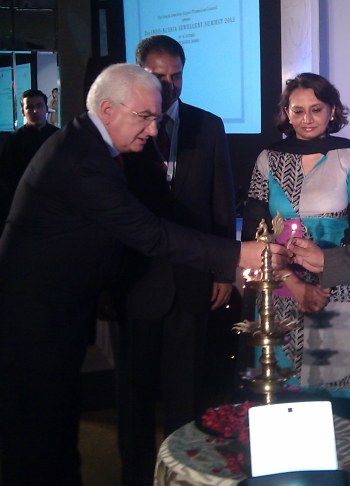
Popov was speaking at the inauguration of the second Indo-Russian jewelry ‘summit’ in Mumbai. The networking event throws Indian jewelry manufacturers together with Russian distributors and retailers.
Explaining that diamonds and jewelry were a low-priority subject with the Russian government, Popov noted that the value of the country’s entire annual production of diamonds amounted to just 1 percent of its oil production or 10 days of natural gas production.
Russia’s jewelry consumption was, however, steadily growing and some 20,000 jewelry retail outlets currently employed about 150,000 people and generated an estimated $16 billion in turnover, he said.
Jewelry retail was not, however, evenly distributed through Russia. Moscow accounted for some 30 percent of the country’s jewelry stores and St. Petersburg for 10 percent, while Russia’s remaining 82 regions – with a population of 130 million people – brought up the remaining 60 percent.
Some 3,200 of Russia’s 4,500 jewelry manufacturers were individual workshops, according to Popov. All told, jewelry manufacture employed some 25,000 people currently.
Despite this, most of state-controlled miner Alrosa’s output was exported and very little reached the domestic market. What little diamond manufacturing there was, tended to be in specific sizes, limited in scope and unsuitable for domestic jewelry manufacture, Popov claimed.
Global brands like Faberge, Cartier and Van Cleef & Arpels had established local distribution centers, imported jewelry at cost and took their profits in Russia.
The lowering of tariff barriers to imports was, he explained, extremely important to the Russian gem and jewelry industry.
IDEX Online News